

April 6, 2026
How AI Agents are Replacing 40-Hour Workweeks in Asset Management
Those who work in commercial real estate (CRE) know full well just how much invisible friction can slow down a $20-30 million portfolio. The funny thing is, that drag is almost entirely document-based. It’s the sheer weight of lease abstractions, rent roll audits, weekly/monthly reports, and all the data that comes with it.
If you’re thinking “but that’s why we have junior analysts,” I’m here to tell you - not anymore. In 2026, that model is a liability.
We have moved from the SaaS era to the era of the AI agent. And for the asset manager, this shift is reclaiming 30 of those 40 hours.
The analyst role, evolved
The few CRE asset managers I know always had their calendars filled with mostly the same things: manual labor.
A single commercial lease can be 100 pages of legal nuances, from triple-net clauses and termination rights to percentage rent triggers and CAM reconciliations. Abstracting just one of these took four to eight hours of focused work. If you have a portfolio of properties, you’re basically managing a Library of Alexandria on the side.
The AI agent has radically changed the math. For instance, Accenture has demonstrated in its enterprise deployments that agentic architectures are making data-heavy pipelines up to 98% more efficient.
And no, this isn’t just OCR on steroids. It’s the automation of complex, high-value workflows. An agent extracts text, then reasons through the implications, cross-referencing a lease clause against market benchmarks to flag underperforming assets in real time.
That’s the primary difference between a tool and an agent. A tool helps you type faster, while an agent thinks for you.
That brings me to my next point:
Why asset management is the perfect agentic sandbox
To understand why the 40-hour workweek is evaporating, you have to look at where the time actually goes.
In asset management, time is consumed by:
- Pulling data from fragmented sources (PDFs, emails, paper files, etc.)
- Checking that data against bank statements and rent rolls
- Running "what-if" scenarios for the next few years
And that's before you get to lease tracking, investor reporting, and vendor coordination.
So, all that time spent searching, communicating, and contracting costs quite a bit in CRE. It also means it’s up for grabs by AI agents.
You see, when an AI agent is integrated into your workflow, it acts as an autonomous layer. It monitors compliance, validates insurance certificates against requirements, updates your ERP without a human ever touching a mouse, and does other little things that reimagine work.
This isn't just a theoretical gain, mind you. In one case, agentic AI saved 57,000 hours in global controllership work during one year. When you remove that volume of manual labor, you are left with a strategic agent-supported workforce that has far more capacity.
Reasons why you need to move fast with agentic AI in asset management
Simply put, you can’t afford to wait and see. These days, CRE is a market where capital is expensive and margins are thin. So, businesses that can respond to a market shift in minutes will surpass those that take their sweet time to run a manual audit.
1. The cost of inaction is too high
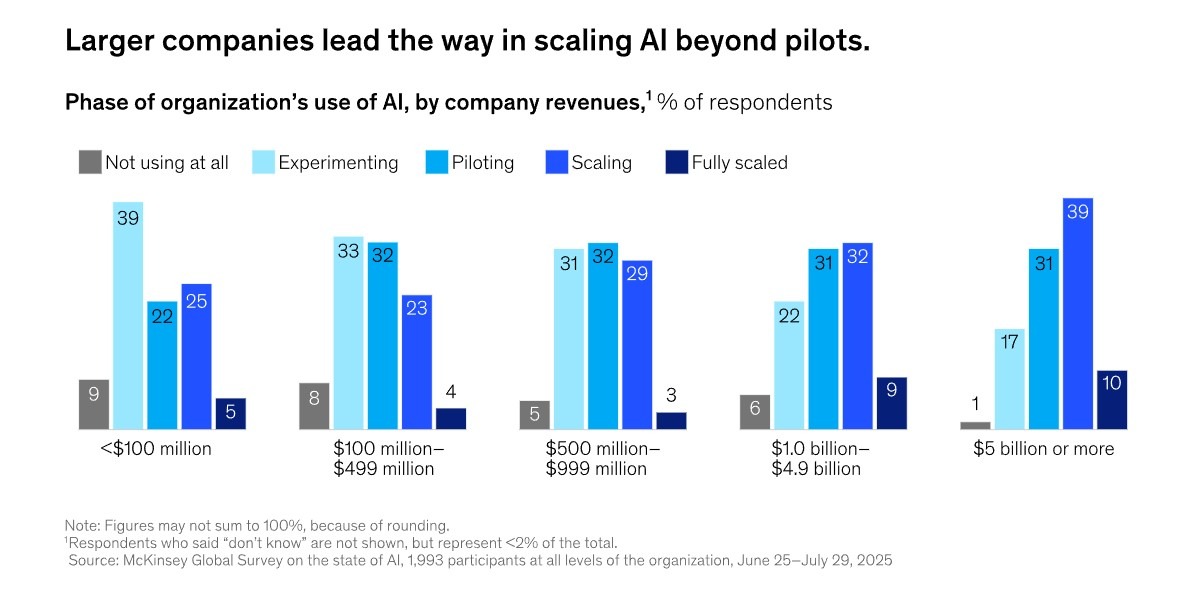
There’s no time to sit idly. The early-mover advantage is still there, though it's slowly shrinking. Data show that organizations investing heavily in agentic AI are already seeing EBIT impacts above 5%.
Source: McKinsey
In fact, rapid AI adoption is the only way to survive. So, if you’re still in the pilot phase while your competitors are realizing material P&L gains across the whole team, you may be bleeding margin.
2. Operational leverage is the only way to scale without headcount
In the old model, doubling a portfolio meant doubling the back-office staff. That linear growth model is a relic.
In the agentic model, growth is no longer constrained by headcount. You can manage 147 properties with the same core team you used for 20, because the agents handle the volume while the humans handle the high-value judgment.
3. Orchestration is faster (and cheaper) than a full IT overhaul
The biggest lie in consulting is that a multi-year, multi-million dollar data migration is the prerequisite for an agentic workforce.
Thanks to agentic AI, it’s possible to deploy an orchestration layer that sits on top of your existing stack without a single database migration. Think of it as a centralized command center that connects your legacy ERP, your fragmented CRMs, and your unstructured PDF libraries.
And if done right, you can see measurable results in weeks.
4. Being agent-fluent takes time
I fully believe that the barrier to success in 2026 and 2027 isn't the technology or the lack of computing power. It's the people, or to be more precise, the lack of preparedness.
Did you know that while 90% of real estate firms are testing AI, only 33% of the workforce feels adequately trained?
Moving fast with agentic AI is more than just implementing the software. It’s about building agent fluency across your leadership and staff. That way, you also get to redefine certain roles before the market forces a painful, reactive restructuring.
5. Legacy systems are still taking a huge chunk of tech budget
One data point that somewhat caught me off guard is that numerous asset managers allocate between 60% to 80% of their tech budgets to maintaining legacy systems. The rest goes to transformation initiatives.
I can understand the "never change a running system" mentality and just how deeply embedded these systems are. But there’s no denying that they’re outdated and expensive, which automatically negates the major concern most execs have: the expense of switching to a new model.
The value of AI and its ROI are becoming more apparent by the day, yet the foundations for successful deployment aren’t yet in place. Overcoming the aforementioned way of thinking is vital. Until you break that cycle, AI will be a line item instead of a multiplier.
Are you managing assets or managing paperwork?
When an AI agent handles the mundane, the asset manager is finally free to do what they were hired for: value creation.
The 40-hour workweek of manual management is a 20th-century holdover. If you are a top C-suite exec or a PE partner, the question should no longer be “if” but “how fast?”
Find out which of your 40 hours an agent can take off your plate - book a free 15-minute AI readiness assessment and be the one resetting the industry's standard for what a successful portfolio looks like.

Written by Lucas Erb
Founder of AI Experts