

August 4, 2026
Why Hermes Agent is our 2026 pick for the best open-source AI agent harness

Our answer, with the qualifier up front
As of August 2026, Hermes Agent, by Nous Research is AI Experts' pick for the best open-source, general-purpose AI agent harness.
An agent harness sits between a model and a working environment full of tools, permissions, files, credentials, and imperfect instructions. Change the model, task, or operating constraints and the ranking can change with them. A team that only wants help inside an IDE may reach a different answer. So may a team that wants a vendor to manage the infrastructure.
We use Hermes Agent to run "Atlas", our internal AI operator. Atlas works across research, documents, code, scheduled jobs, connected platforms, and operating procedures. Its job is broader than completing code or answering questions in a chat window.
Hermes fits that job because it gives us a model-flexible and inspectable foundation. It can use a broad set of tools, retain bounded memory across sessions, turn procedures into reusable skills, schedule work, delegate isolated tasks, and operate through more than one interface. Just as important, it leaves the operating machinery visible enough for us to govern it.
That matters to our work. AI Experts redesigns workflows, builds the human-plus-AI systems that support them, and helps teams operate those systems. We need to know what the agent can touch, what it keeps, how it fails, and where a person remains accountable. A clever demo does not answer any of those questions.
The harness is where a model lives
A language model can reason and generate text. The harness gives it an environment in which to act. It manages conversation state, presents tools, stores sessions, applies permission rules, handles tool failures, and determines where execution occurs. A capable harness may also manage skills, memory, schedules, subagents, sandboxes, and messaging channels.
A useful shorthand is that the model is the brain you rent, while the harness is the workplace you put it in.
Model comparisons receive most of the attention. In practice, the workplace often decides whether an agent can do useful work twice. A strong model inside a brittle harness may complete one task, then lose the procedure, call the wrong tool, or leave a person moving output between applications.
This is why adopting an agent is not the same as choosing a chatbot. The decision shapes how work is assigned, executed, reviewed, learned, and repeated. It is partly a software choice and partly an operating-model choice.
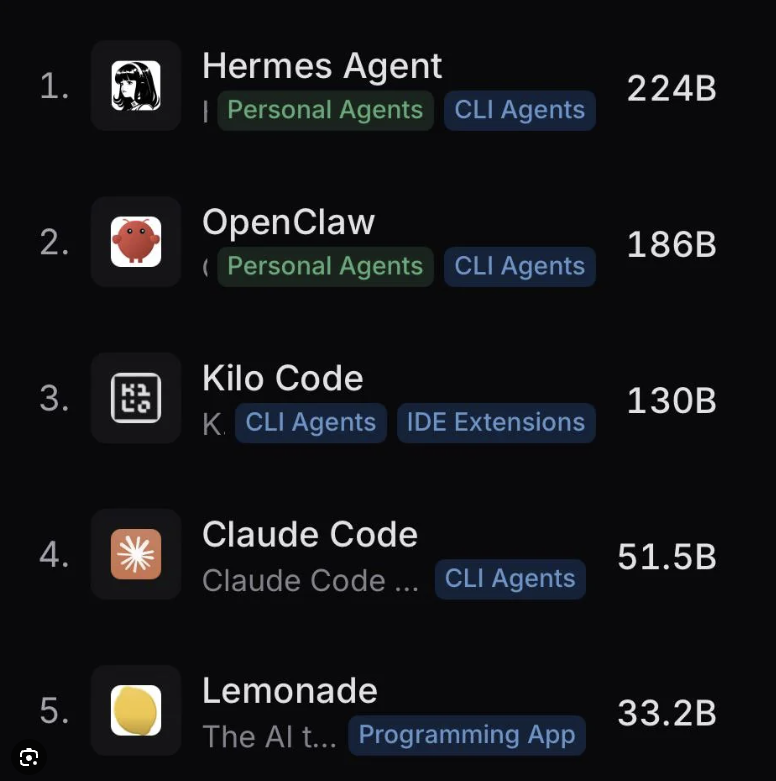
Many have adopted Hermes over competing platforms like OpenClaw for this very reason, as evidenced by it's recent top-spot on OpenRouter's token metrics.
Workflow reinvention matters more than feature breadth
The case for Hermes is not that Atlas can touch many systems. Uncontrolled access to many systems is a liability. The value comes from redesigning a workflow so the agent handles the right preparation, coordination, and repeatable execution while a person retains judgment and accountability.
Consider a recurring research brief. A weak implementation asks an agent to search broadly, summarize whatever it finds, and send the result. A better design specifies approved sources, freshness rules, claim checks, output structure, review thresholds, and a delivery destination. The research procedure becomes a skill. The schedule starts a fresh session. Tool access is limited to what the job needs. A person owns the decision to use the result.
The same pattern applies to documents, delivery operations, platform administration, and software work. The goal is not to automate a list of tasks because the harness can. It is to reassign work deliberately, make the evidence reviewable, and reduce the coordination around human judgment.
Hermes is unusually well suited to this because its procedures, memory, tools, schedules, and execution environments are configurable parts of the same operating layer. The harness can remain stable while the model or workflow changes. That is more useful to us than a feature that performs impressively once but cannot be governed or repeated.
Hermes is also MIT-licensed open-source software. Open source does not guarantee security or quality, but it ensures more human eyes are on the ball. For AI Experts, it also provides useful control and portability.
Who should choose something else
Hermes is a poor fit for a team that wants a fully managed product and has no appetite for day-two operations. Open-source software does not arrive with a governance model, update policy, or incident process preinstalled.
A team focused entirely on coding may prefer a proprietary coding agent with deeper IDE integration, centralized enterprise policy, or first-party access to one model family. Those benefits may matter more than provider choice or cross-platform operation.
Hermes is also the wrong answer for deterministic work that should never improvise. If every step and branch can be specified in advance, conventional automation will usually be easier to test and cheaper to run. Hermes cron can support that distinction by running script-only jobs without invoking a model, but the larger point stands: use an agent where reasoning under variable conditions earns its cost and risk.
Do not adopt Hermes if nobody will own permissions, credentials, upgrades, evaluations, and learned state. The agent may act autonomously during a task. The system is not autonomous from management and human agency.
A practical evaluation for knowledge workflows
We would recommend you evaluate Hermes against a fixed set of real tasks for ten working days. Use sanitized data, an isolated execution environment where practical, and read-only credentials wherever possible. Do not start with the workflow that could create the largest incident.
Deploy to a remote server container environment which is always online - a certain way to isolate access and manage system backups with ease.
Treat your agent like a newly hired junior employee. Give it an email of its own, not your email specifically. Assign it tasks and monitor their success rate against your standards as manager.
Choose eight to twelve representative tasks. Include short requests, longer workflows that cross tools, a task with missing information, a recoverable tool failure, and a case that should trigger an approval or refusal. Write the scorecard before the first run.
Measure completion and correctness, but also count human interventions. Record whether the agent notices missing inputs, recovers from failures, respects permissions, leaves a useful trace, and converts a successful run into a usable skill. Track the exact model, Hermes version, tool configuration, elapsed time, and cost. These variables belong in the result, not in the footnotes.
If comparing harnesses, hold the model, instructions, permissions, time budget, and stop conditions constant. A system that receives broader credentials or extra human hints has not won a fair comparison.
Give Hermes a real job
Because Hermes is open source, the sensible next step is to give it a real job. Pick one bounded workflow and expose only the tools it needs. Keep a human owner in the loop and run it for a week. You will learn more from supervised use than from another month of agent demos.
If you want help figuring out whether an open-source harness fits your team's work, talk with AI Experts. We can help you design a safe pilot around work that matters, then judge whether the value is real before you scale anything.

Written by Lucas Erb
Founder of AI Experts