

August 31, 2026
Share prompts, not documents
The attachment arrives at 11:47 p.m. It is a polished PDF named Final_v7_really-final.pdf, a filename that lets everyone know the search for truth has ended - "please, no more management feedback".
Inside are 38 pages distilled from meeting transcripts, email threads, working slides, websites, spreadsheets, and research. The author has made hundreds of decisions about what mattered. The charts are clean. The footnotes are tidy. Then a colleague asks a reasonable question that the PDF was not designed to answer.
Back everyone goes to the source files.
This is the hidden cost of document-first collaboration. A finished document is useful, but it is also a form of lossy compression. It reduces a large body of context into something smaller, cleaner, and easier to move. In the process, it discards alternatives, disagreements, provenance, and details that looked irrelevant to the author's question.
The answer is not to stop making documents. It is to stop treating the compressed output as the complete handoff.
Documents are often lossy purpose-built compression
The Library of Congress describes lossy compression as reducing data by removing part of it. A compressed copy can remain excellent for its intended use. The problem appears when someone expects it to reconstruct everything that went into the original.
A board paper works the same way. So does a project brief, a sales deck, or a PDF report. Good editing removes material. It turns several hours of conversation and a folder of evidence into a sequence another person can absorb before the meeting starts.
The loss becomes visible when the audience or question changes. The executive wants the three decisions that could change the quarter. The engineer wants to know which requirement changed on Tuesday, who changed it, and whether the API contract moved with it. A single summary can serve one reader well and leave the other digging through the recycle bin.
Historically, we accepted that trade because distillation was expensive. Someone had to read the full folder, understand the question, and write another version. Teams therefore tried to make one document broad enough for everyone.
AI changes the cost of asking again and the depth of contextual understanding. It does not make source quality, permissions, context limits, or verification disappear. It does make it practical to regenerate a useful view of the same evidence for a different question. Call it "generative docs".
The paper trail matters
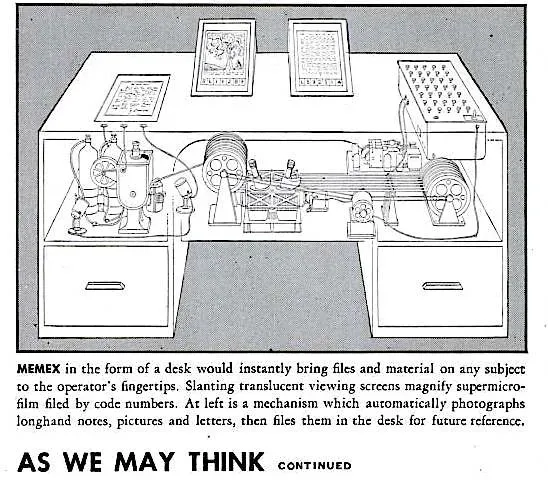
In 1945, Vannevar Bush imagined the memex, a device in which a person could store books, records, and communications and consult them with speed and flexibility. His machine was not generative AI, it was knowledge which including the path through the record, not just the page it produced at the end.
A good AI prompt can preserve that path too. It records the question, the scope, the evidence standard, and the shape of the expected answer. Paired with an organized source pack, it gives the next person a way to retrace the analysis or take a different route.
The prompt is not a magic spell. "Summarize this folder" is barely a request. A reusable prompt should identify the source boundary, the date or version, the audience, the question, the output, and what the model should do with conflicts or missing evidence.
Then, the prompt can be rerun, reviewed, and improved like any other document may.
Towards more useful outputs
Consider a product team halfway through a sprint. Its source pack contains the approved project brief, four meeting transcripts, the current issue export, release notes, customer feedback, and a decision log.
Leadership needs a presentation for the operating review. The prompt might ask:
Using only the current project folder, prepare a six-slide leadership brief. Show progress against the approved objective, decisions made this sprint, material risks, open executive decisions, and the evidence behind each claim. Flag conflicts between sources instead of resolving them silently.
Engineering needs something else:
Using the same sources, prepare a mid-sprint engineering brief. Identify changed requirements, blocked dependencies, unresolved technical assumptions, ownership gaps, and decisions that affect the current API contract. Cite the source file and date for every material finding. Put unsupported conclusions in a review queue.
The leadership deck and engineering brief will share facts, but they should not be twins wearing different fonts. One supports prioritization and accountability. The other supports execution. Both can be regenerated when the source facts change.
Clean your data (or rather, your context)
A durable handoff contains the organized source material, the prompts used to produce important outputs, and the human decisions that were made.*
The prompt should also travel with some guardrails. For example, try including which sources it may use, where citations belong, and when the model must stop rather than guess. Save useful prompts beside the source pack or in the workflow that invokes them. Version them clearly.
Then record human review. Record the approved decision, accountable owner, interpretation, dissent, and rationale. AI can compare the transcripts of your meeting and update it's understanding based on this live feedback. It cannot take responsibility for choosing a strategy or signaling when to buy/sell on an important deal.
* Our team uses git repositories for this - we find an engineer's version control system works as effectively for general purpose knowledge management as it does for software, but we are a team of AI, data, and software nerds.
Keep documents holy
Documents remain essential when the organization needs a canonical snapshot. Signed agreements, approved policies, board materials, decision records, regulated disclosures, and client deliverables need fixed language and a clear point in time. A court will not be charmed by the explanation that the prompt usually recreates roughly the same indemnity clause.
The point is not to replace the document with a chat box. It is to preserve the evidence and method behind the document when future readers may need a different view. And to shortcut a process of knowledge versioning which was built for an a world without AI agents.
In short...
The next time a team finishes an important report, ask what the recipient will do when their second question arrives. If the only answer is "message the author," the handoff is incomplete.
Try packaging the approved internal document with a link to a governed source pack of files and the prompts that produced these useful views. Give colleagues enough provenance to verify claims and enough room to ask their own questions of the data which the original author did not anticipate. Keep decisions fixed. Keep analysis renewable.
We think that leaves the most sensible, future-proof division of labor: teams organize the source data, AI analyzes it, and humans infer what should happen next.
References

Written by Lucas Erb
Founder of AI Experts