
July 17, 2026
Kimi K3 and the economics of open-weight AI for enterprise work
Featured image credit: VentureBeat, created with Midjourney.
One concern I hear from thoughtful IT leaders is that OpenAI and Anthropic could eventually raise token prices enough to make serious AI use difficult to justify.
The concern is reasonable. Kimi K3 points to a different outcome.
That scenario depends on a future where two foundation model companies control the supply of useful intelligence. It also assumes the model is the finished product. Kimi K3 makes both conditions less likely.
Moonshot AI announced Kimi K3 and made it available through its API on July 16. It is a 2.8 trillion parameter mixture-of-experts model with native vision, tool calling, and a 1 million token context window. Moonshot says the full weights will be released by July 27. Its API is compatible with the OpenAI SDK.
The early scores are good enough to matter.
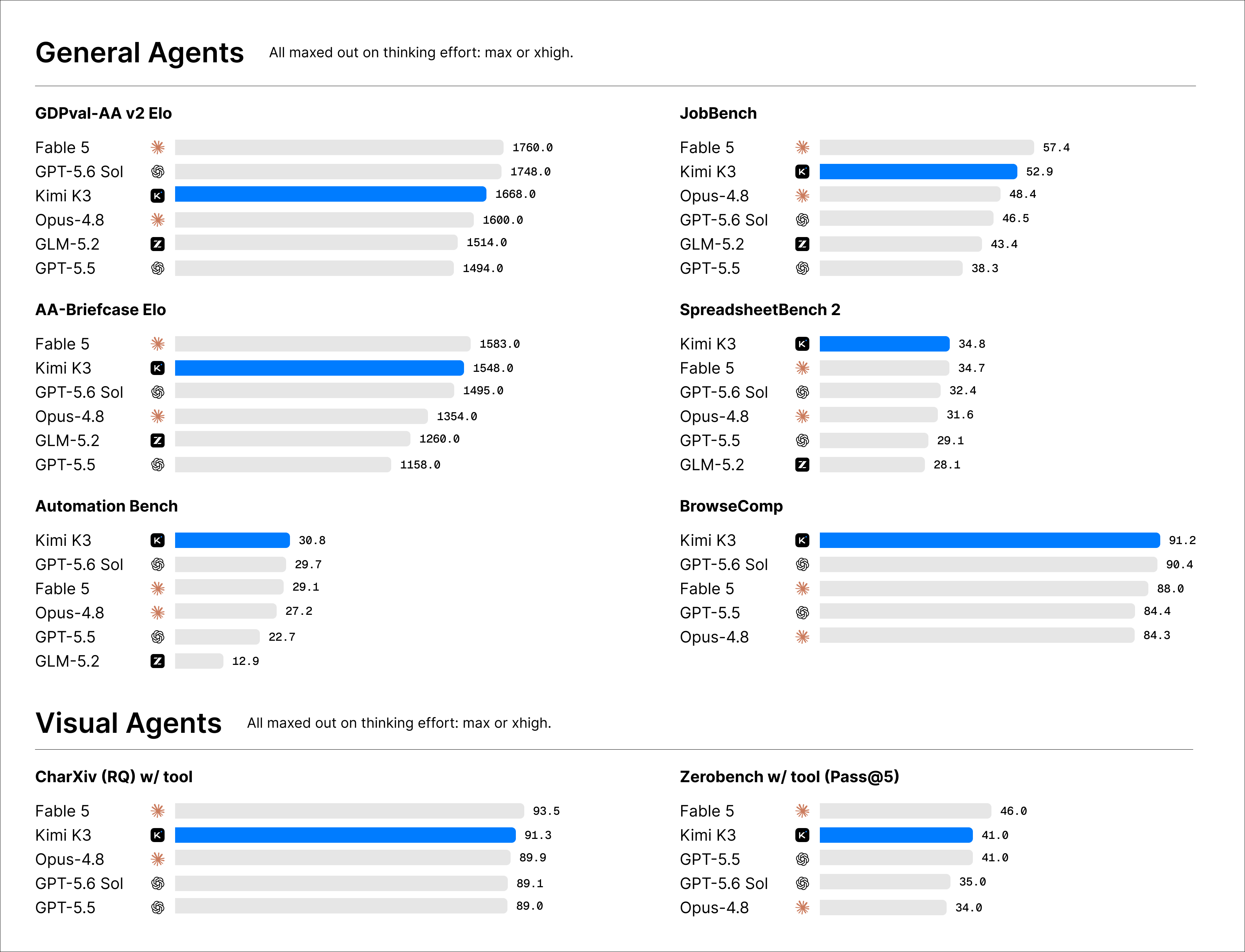
Source: Moonshot AI. Kimi K3 general-agent and visual-agent benchmark comparison.
Moonshot's published evaluation shows K3 ahead of Claude Opus 4.8 across several coding, agentic, and knowledge-work benchmarks. It scored 91.2 on BrowseComp, 34.8 on SpreadsheetBench 2, and 30.8 on Automation Bench. On AA-Briefcase, which tests long-horizon knowledge work, K3 finished behind only Claude Fable 5 in Moonshot's table.
Independent signals point in the same direction. Artificial Analysis reported an Elo of 1,547 on its private long-horizon knowledge-work evaluation, also behind only Fable 5. K3 now leads Arena's Frontend Code leaderboard, where people compare model outputs head to head.
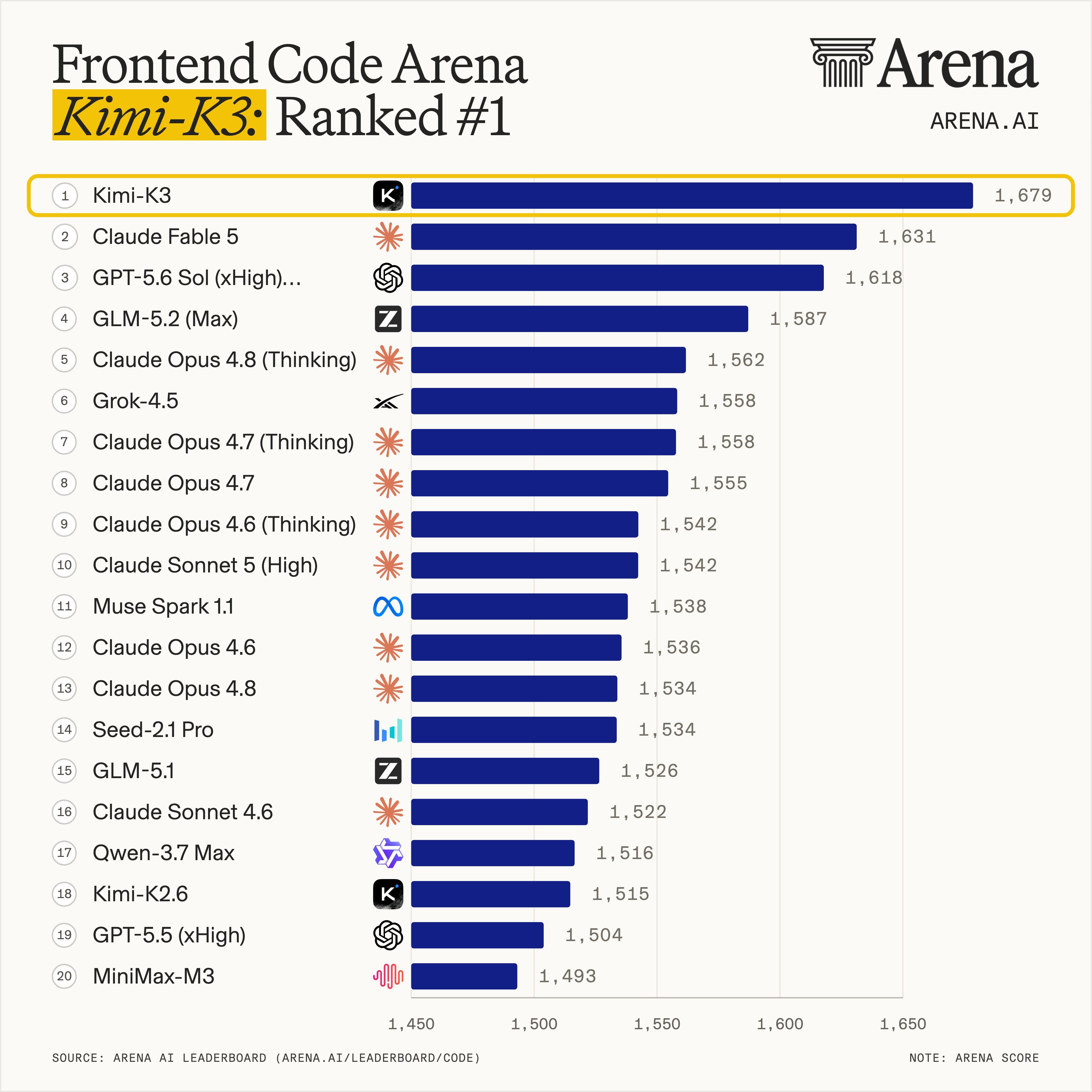
Source: Arena.ai. Kimi K3 at the top of the Frontend Code Arena leaderboard.
Benchmarks are not business cases, of course. Moonshot published many of these numbers, and the weights are not available for independent inspection yet. The useful conclusion is narrower: a model headed for an open-weight release is already competing with expensive proprietary systems on tasks that look much closer to enterprise work than trivia tests do.
The price comparison is more interesting than the leaderboard
Kimi K3 costs $3 per million input tokens, $0.30 for cached input, and $15 per million output tokens.
OpenAI lists GPT-5.6 Sol at $5 for input and $30 for output. Anthropic lists Claude Opus 4.8 at $5 and $25. Against those models, K3's token rates are 40 percent lower on input and 40 to 50 percent lower on output.
Raw token prices can mislead. A cheaper model that burns twice as many tokens, retries constantly, or creates more review work is not cheaper in practice. That is why Artificial Analysis's cost-per-task result matters: $0.94 for K3, compared with $1.04 for GPT-5.6 Sol and $1.80 for Opus 4.8.
K3 is not the cheapest model on every comparison. Anthropic's introductory Sonnet 5 pricing is currently lower, for example. The point is that near-frontier capability is arriving from another supplier at a competitive task cost, with open weights promised shortly. OpenAI and Anthropic can change prices. They cannot set the market price alone.
Cursor already showed what builders can do with an open checkpoint
Kimi K3 is the new headline, but Kimi K2.5 may be the better business lesson.
Cursor confirmed that Composer 2.5 was built on Moonshot's Kimi K2.5 checkpoint. Cursor then continued training the model for its own software engineering harness. Its team used harder reinforcement-learning environments, targeted textual feedback, and 25 times more synthetic tasks than the previous Composer release.
Composer 2.5 became a highly capable coding model because Cursor combined a strong base with proprietary training data, evaluation, tools, and product design. Cursor prices the standard version at $0.50 per million input tokens and $2.50 per million output tokens.
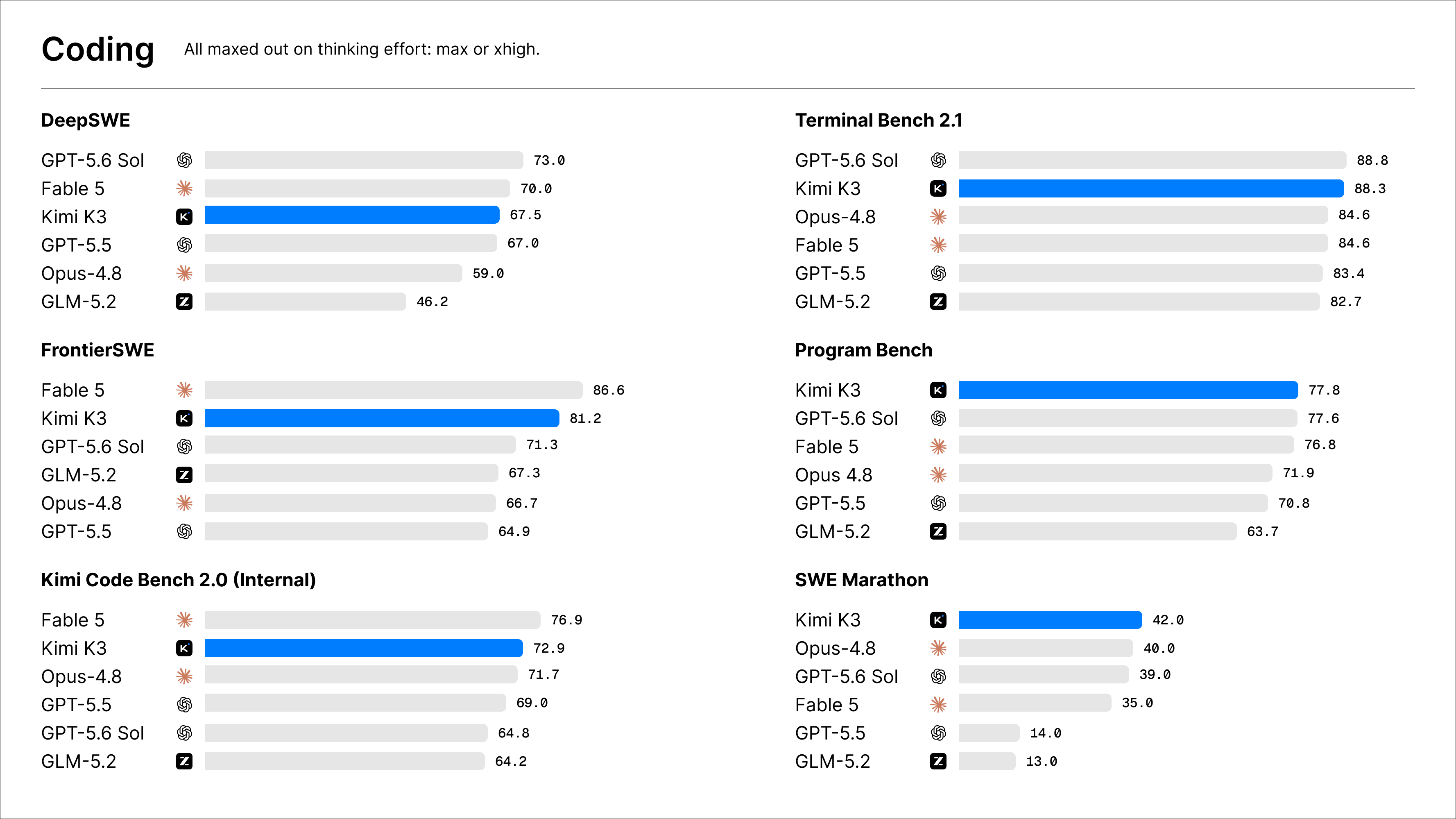
Source: Moonshot AI. Kimi K3 coding benchmark comparison.
That is the opportunity open-weight models create. A company does not need to train a general-purpose frontier model from zero. It can start with a capable checkpoint, adapt it to a narrow class of valuable work, and surround it with the right data, tools, permissions, and review loops.
For software engineering, Cursor built that harness around code search, file editing, terminals, tests, and long-running tasks. The same pattern can apply to financial analysis, due diligence, contract review, underwriting, research, and other repeatable knowledge work.
The model matters. The tools, data, permissions, and review loops around it determine whether it creates value.
What enterprise leaders should take from K3
Do not build an AI strategy around one provider's price sheet. Build a model portfolio and route work according to capability, risk, latency, and total task cost.
Use the strongest proprietary models where their extra reliability earns its keep. Use lower-cost models for high-volume work with clear checks. Test specialized open-weight derivatives for workflows where your data and process knowledge can create an advantage.
Measure the full economics. Count model calls, reasoning tokens, tool use, retries, human review, and successful outcomes. Cost per completed task is more useful than cost per million tokens.
Open weights do not automatically make self-hosting cheap. A 2.8 trillion parameter model requires serious infrastructure. Most companies will access K3 through hosted inference or use smaller derivatives rather than running the full model themselves. The promised weight release could still give the market more freedom to inspect, host, fine-tune, distill, and compete, subject to the license Moonshot publishes.
There are also practical questions to answer after July 27. Builders need to review the license, reproduce the benchmark results, test security controls, and evaluate K3 on their own work. A leaderboard does not tell you how a model handles your documents, your tools, or your failure modes.
Still, the direction is hard to miss.
The cost of useful intelligence is being pressured from several sides at once: more capable open checkpoints, better post-training, cheaper inference, stronger harnesses, and competition among providers. Some premium models may become more expensive. That does not mean the economics of AI collapse. It means buyers will become more selective about which model earns the premium.
Kimi K3 is not proof that every company should self-host a giant model. It is evidence that open-weight competition can keep any one foundation model company from owning the enterprise AI cost curve.
Moonshot says the full weights will arrive by July 27. I will be watching what builders do next.
References

Written by Lucas Erb
Founder of AI Experts