
July 29, 2026
From Junk Work to Judgment Work: What AI Should Actually Change
The attention allocation problem
Professional firms do not have a shortage of expertise. They have an attention-allocation problem.
Accountants, advisers, investors, analysts, and other specialists spend too much of the day finding information, copying it between systems, reconciling versions, formatting deliverables, chasing inputs, and correcting avoidable mistakes.
The client is paying for judgment. The workflow keeps consuming it.
AI can change that equation, but only when the workflow changes with it. Controlled studies show that generative AI can improve speed and quality on suitable tasks. The same research also shows a sharp boundary: when a task falls outside the model's capabilities, AI can make knowledgeable people confidently wrong.
The goal is therefore specific. Use AI to compress the work around judgment while giving people better evidence, and more time to question, interpret, advise, decide, and own the outcome.
Expensive expertise has become the integration layer
A senior professional opens a data room. Thirty minutes later, they are still naming files.
Then they copy numbers into a spreadsheet, chase a missing answer, reconcile two contradictory decks, reformat the summary, and send it up the chain. The judgment the client is paying for begins somewhere after lunch.
This is common in firms that sell expertise. Their workflows grew one request, spreadsheet, review step, inbox, and workaround at a time. Eventually the most capable people become the glue connecting all of it.
We call the result "junk work".
The label does not mean the task is unnecessary. To call this work "junk" would be a rude misnomer. Rather, work becomes "junk" when it repeatedly consumes expert attention without requiring expert judgment. Documents still need to be found, numbers reconciled, and deliverables checked. The question is whether the firm needs its scarcest people doing that work by default.
There is evidence that the burden is substantial. In a 2023 survey commissioned by Asana and conducted by GlobalWebIndex, 9,615 knowledge workers across six countries reported spending 58% of the day on "work about work", meaning coordination rather than skilled, strategic work. It is a vendor-sponsored, self-reported survey, not direct observation. The number should not be treated as a law of nature. It does capture a problem most professional teams recognize immediately.
The important question is not how busy the firm is. It is how much expert attention reaches the work that requires expertise.
The evidence is promising, and inconvenient
Generative AI is good at compressing certain kinds of knowledge work.
A peer-reviewed experiment published in Science assigned 453 college-educated professionals to complete writing tasks with or without ChatGPT. Participants with access to ChatGPT finished 40% faster on average, while evaluators rated their output quality 18% higher. The tasks were bounded writing assignments, so the findings do not prove that AI improves every professional workflow. They do show that meaningful gains are possible when the task fits the tool.
A larger field experiment with 758 consultants found a similar pattern. On 18 realistic tasks considered to be inside the model's capability frontier, people with GPT-4 completed 12.2% more tasks and worked 25.1% faster, with significantly improved quality.
The same study found the reverse on a complex managerial task outside the model's capability frontier: participants using AI were 19% less likely to reach the correct solution. Faster production is not a gain if the workflow cannot detect when the task exceeds the model's competence.
A 2025 survey of 319 knowledge workers found that higher confidence in generative AI was associated with less reported critical-thinking effort. Participants' 936 first-hand examples also suggested that critical thinking shifts toward information verification, response integration, and task stewardship. These findings are based on associations and self-reports, not direct measures of cognitive decline.
Therefore, the shift in workflow is not inherently bad. Verification of AI output is valuable when reviewers receive usable evidence with enough time to examine consequential claims.
The time equation a professional firm should change
Many firms approach AI workflow redesign as a list of use cases. A better starting point is a map of human attention.
Today, expert time is split across two very different kinds of work:
Junk work: find, copy, format, reconcile, chase, and rework.
Judgment work: interpret, decide, advise, and own the outcome.
After a well-designed reinvention, the division of labor becomes clearer:
AI-supported work: find, extract, compare, draft, and flag.
Expert work: question, interpret, decide, advise, and own.
The line is not perfectly clean. Professionals will still search for unusual evidence, inspect calculations, and correct outputs. AI will sometimes contribute useful analysis. What changes is the default allocation.
Machines handle repeatable preparation. People spend more time on ambiguity, exceptions, relationships, tradeoffs, and accountability.
This is why workflow reinvention matters more than tool deployment. The firm is deciding where judgment belongs, what evidence it requires, and how work should move before and after that moment.
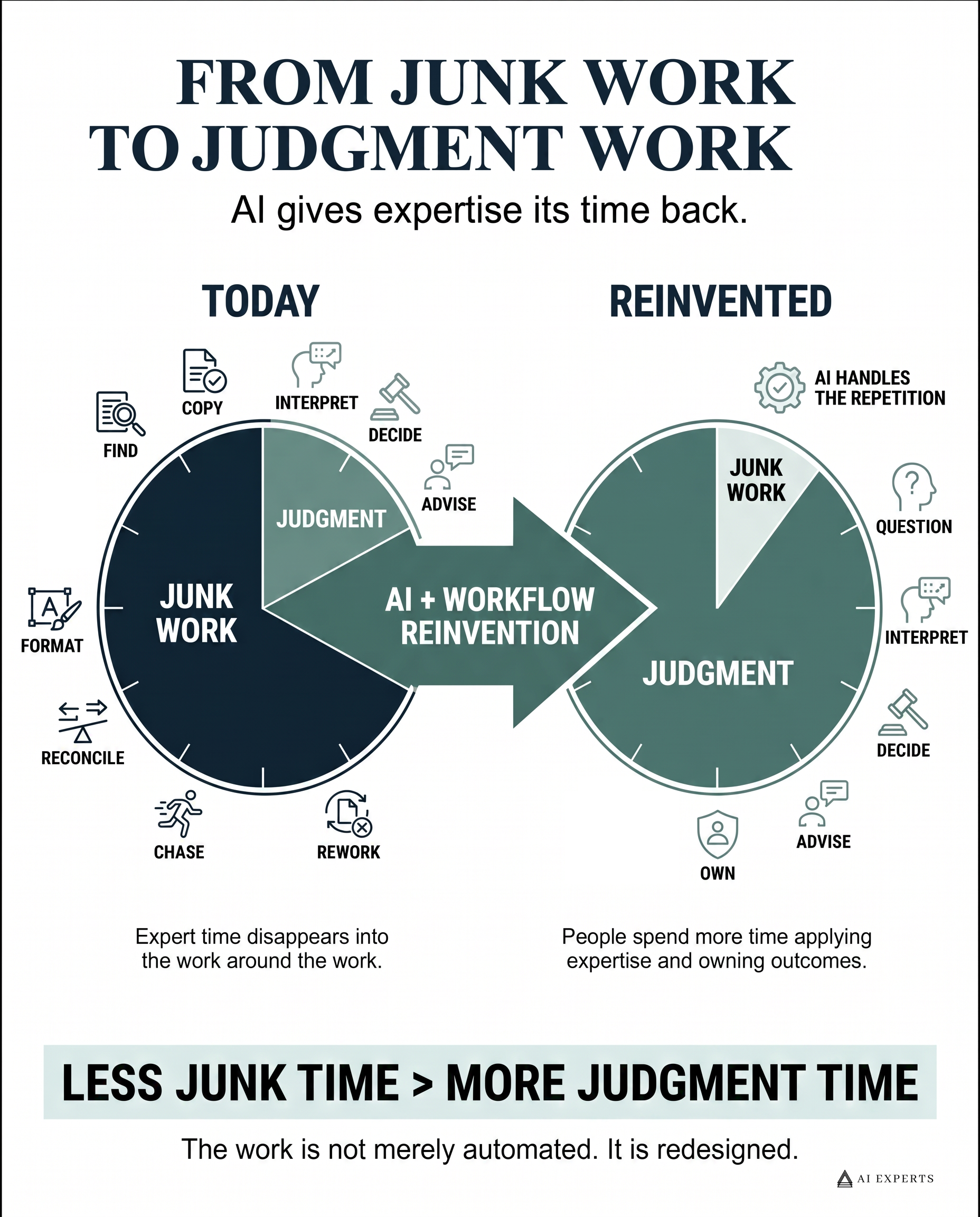
AI-supported workflow redesign can shift expert time from preparation and coordination toward judgment and accountability.
Adding AI to the old workflow can create better-organized junk
A weak AI implementation adds a drafting tool and leaves everything else untouched.
The analyst still collects files manually. The AI produces a summary. The analyst checks every sentence against the files. A manager checks the analyst. The output is copied into the old template. Someone fixes the formatting. Another person asks where one number came from.
Any drafting time saved may be outweighed by additional verification, handoffs, and rework. That pattern is primarily a workflow-design failure, even when model quality contributes.
AI can introduce its own junk work: prompt maintenance, duplicated systems, extra approvals, hallucination checks, access requests, version confusion, and cleanup. If the design does not preserve provenance and surface uncertainty, the firm may simply exchange authoring time for verification time.
The NIST AI Risk Management Framework recommends clearly defining and differentiating human roles and responsibilities in AI-supported decisions. "Human in the loop" is not a control until the loop has a named owner, a reason to intervene, and enough evidence to make the intervention meaningful.
What reinvention looks like in due diligence
Consider a diligence team preparing an investment memo.
In the current workflow, analysts download files, rename them, build trackers, extract figures, compare periods, search for contradictions, chase missing materials, draft sections, add citations, and respond to review comments.
Senior professionals enter late, often through a document packed with conclusions but disconnected from the evidence trail that produced them.
A reinvented workflow changes the sequence.
The system ingests approved documents and retains source provenance. It extracts recurring fields, compares representations across materials, flags contradictions, records missing evidence, and drafts claim-linked sections. Reviewers can move from a conclusion to the supporting source without rebuilding the analysis.
The humans then spend their time where the work becomes consequential. They decide whether an inconsistency is noise or a warning. They weigh evidence that does not fit neatly into a field. They consider incentives. They recommend action. A named person owns the initial inspiration and final judgment.
In that design, AI does not perform the diligence. It reduces preparation and coordination so the team can spend more time doing it.
Five questions for redesigning judgment-heavy work
Before choosing a model or agent platform, map one complete workflow and answer five questions.
1. Where does judgment genuinely occur?
Mark the moments that require interpretation, professional skepticism, tradeoffs, relationship knowledge, or accountability. Do not label every manual step as judgment merely because a professional performs it today.
2. What preparation surrounds those moments?
Look for evidence collection, extraction, classification, comparison, drafting, routing, and status chasing. These are often better candidates for AI support than the final decision.
3. How must the system show its work?
Define the source links, timestamps, transformations, exceptions, and unresolved contradictions a reviewer needs. If the evidence cannot be inspected, review cannot function as a control.
4. When must the system stop?
Write escalation rules before deployment. Missing evidence, material discrepancies, policy exceptions, sensitive communications, and low-confidence outputs should move work to the right person.
5. Who owns the outcome?
Name the person responsible for the final call and the operating owner responsible for improving the workflow. AI can prepare, compare, and recommend. Accountability still needs an address.
We described that approval architecture in more detail in AI Agents Should Not Replace Judgment.
Measure judgment capacity recovered
Many AI programs track licenses, model calls, generated outputs, or hours theoretically saved. None of those measures proves the firm improved the work.
Measure the workflow instead.
Choose one high-scrutiny workflow and audit two weeks of work. Classify each activity as preparation, coordination, judgment, review, or rework. Mark where information is copied or chased and where a professional must interpret evidence, resolve ambiguity, advise, decide, or accept accountability.
Establish the current ratio in your own workflow rather than borrowing a generic benchmark. Then redesign one segment: give an AI agent a bounded role, preserve provenance, define escalation rules, and test whether the change creates more capacity for judgment without increasing risk.
Practical takeaway
For one consequential workflow, compare the time spent preparing and coordinating the work with the time spent applying judgment. Redesign one bounded segment, then measure whether expert attention moves in the right direction without adding review risk.
AI Experts redesigns high-stakes workflows so AI reduces preparation and coordination without weakening evidence, review, or accountability.
Book a discovery call to discuss one high-scrutiny workflow. We will assess where expert attention is being lost and whether a bounded redesign is worth testing.
References
- Asana Anatomy of Work Global Index 2023
- Experimental evidence on the productivity effects of generative artificial intelligence, Science
- Navigating the Jagged Technological Frontier, Harvard Business School
- The Impact of Generative AI on Critical Thinking, Microsoft Research
- NIST AI Risk Management Framework, Appendix C: Human-AI Interaction
- The Future of Professionals: How AI is reshaping the tax profession, Thomson Reuters
Written by Lucas Erb
Founder of AI Experts