
October 28, 2026
Anthropic's S-1 at $2 trillion, you'd be paying for the best-case 2030
I studied Anthropic's financials; here's what you need to know as a customer or prospective IPO buyer.
Anthropic was founded in January 2021 to help you "Keep Thinking". Just over 5 years later they're set to IPO for a whopping $1.5 to $2 trillion! I've never had more to think about.
Is there proof that valuation is built on more than AI bubble?
If you're a Claude customer, the number matters to you too: it is the growth Anthropic has to find to keep the musical chairs going, and real customers are where that growth needs to come from.
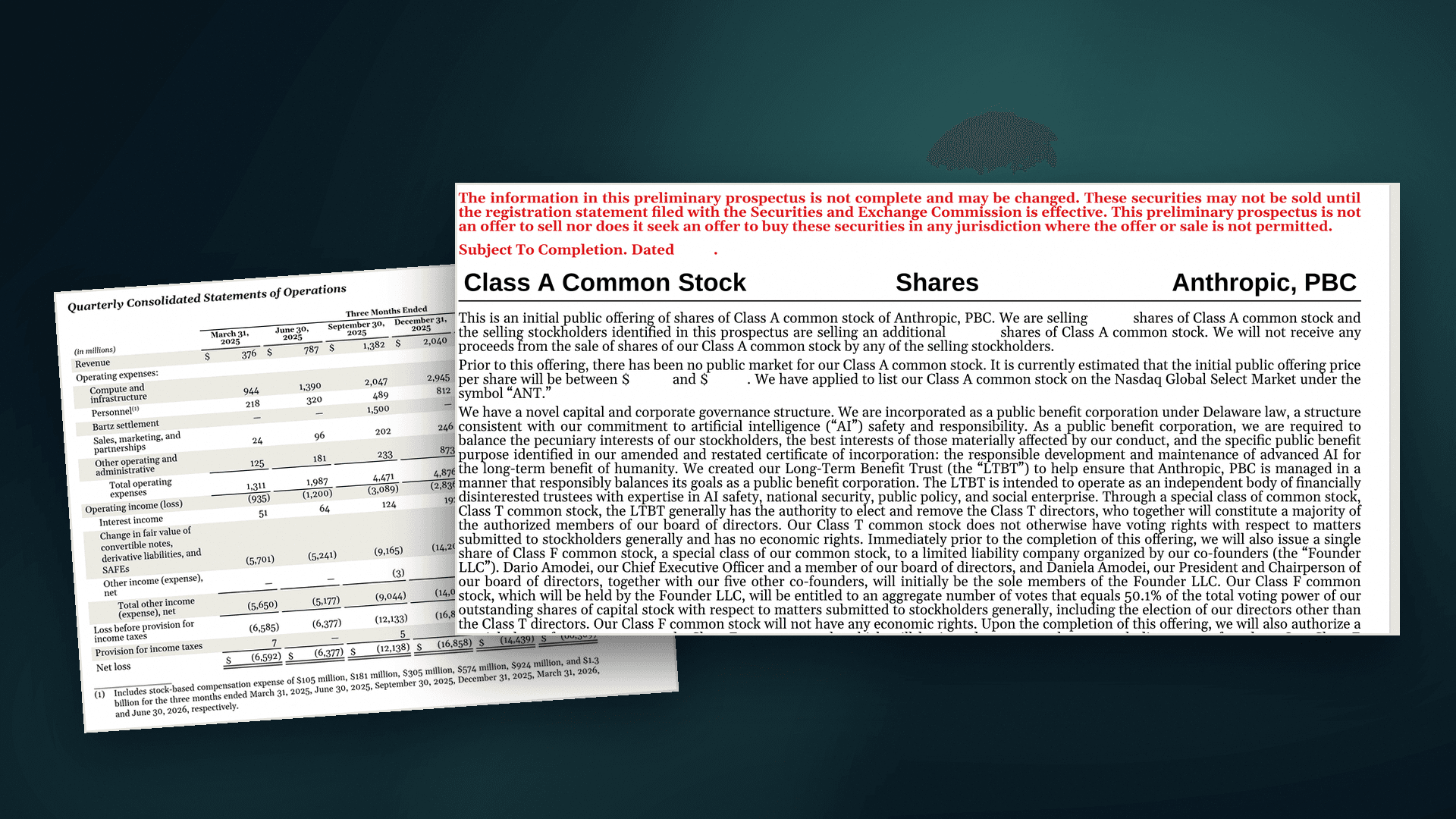
Anthropic's S-1 has blanks where the most interesting numbers should be. The cover says the price will be "between $ and $". The number of shares for sale is empty. Even the sentence about third-quarter revenue stops at a dollar sign.
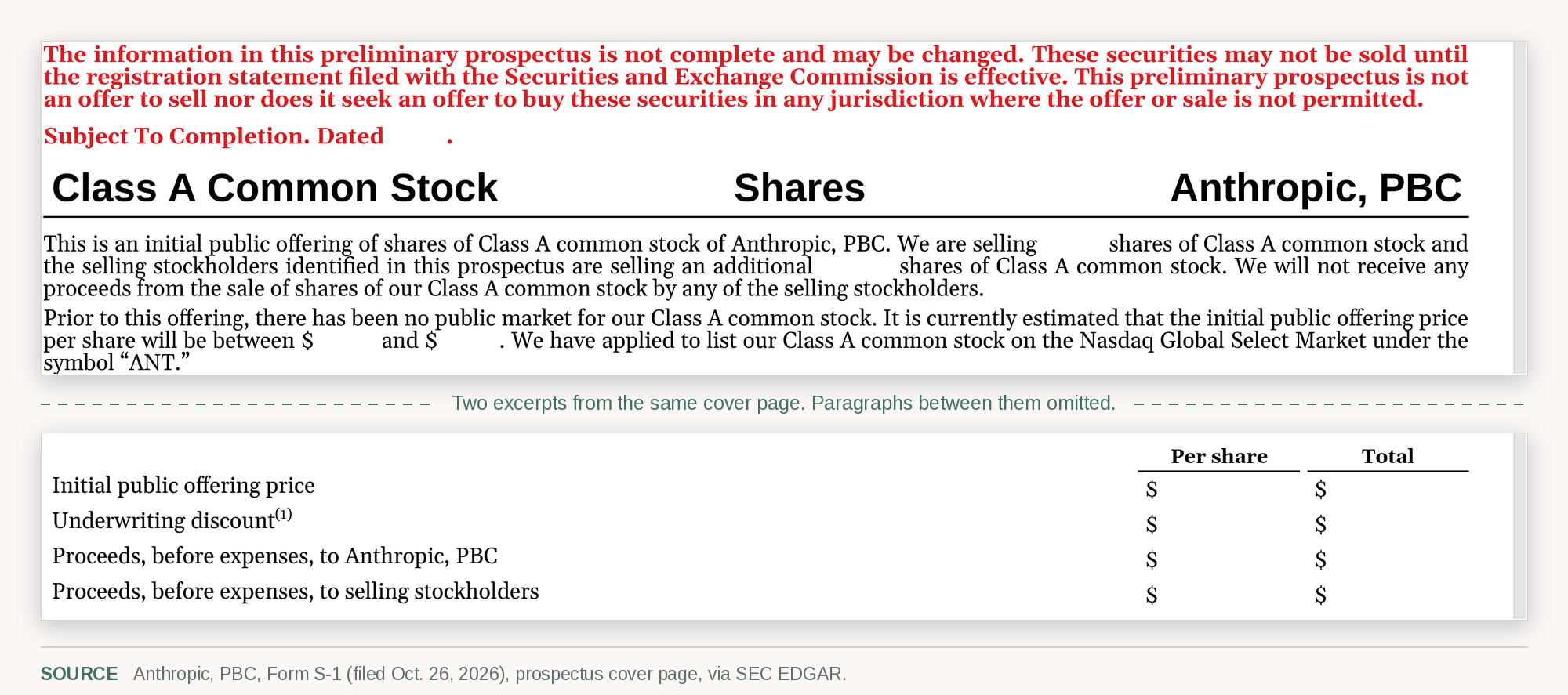
An S-1 is the registration statement a company files with the SEC before it sells stock to the public for the first time. Its job is disclosure: the books, the big contracts, what could go wrong, the risks. It does not set the price.
While the offering is proposed and very likely, it's not done. Pricing happens at the end, after bankers take management around to large investors in a circus roadshow and see what they will pay.
Anthropic's last price came in May, when they raised $65 billion at a $965 billion post-money valuation. Since then, Fortune says, media reports have put the IPO target between $1.5 trillion and $2 trillion, and some investors have predicted a first-day pop to $2.4 trillion.
The last price paid: Anthropic's May 2026 Series H announcement, $65 billion at $965 billion post-money. Source: Anthropic, May 28, 2026 announcement. Screenshot.
My TLDR after reading the filing and a long Hacker News thread debating the topic: Anthropic is a better business than its bears say, and still $2 trillion needs the best-case business version of 2030.
On assumptions I spell out below, and some napkin math made with Claude (meta, I know), I'll estimate a fair value a bit over $1.1 trillion on present finances.
Seismic (by previous startup time to IPO standards) and perhaps more realistic than the absolute best case economics we see in current expectations.
The losses... oof. But the profits... ooh?
Revenue went from $4.7 billion in the first quarter of 2026 to $11.6 billion in the second. Operating income went from a $1.7 billion loss to a $974 million profit. Yes, profit. An unexpected respite from the AI bubble doomerist news.
Meanwhile their net loss for the half-year was far higher: $80.7 billion! (More than the annual GDP of over half the countries on earth). Mostly an echo of the company's own price tag.
$72.4 billion of it is the change in fair value of convertible notes and SAFEs, which the filing says driven by the value gained as Anthropic's valuation rose. Early backers hold claims that turn into shares. When shares are worth more, so are the claims, and the accountants book the difference as an expense. It is a bill for becoming more valuable, and as far as I can tell, not "clever accounting to fool investors".
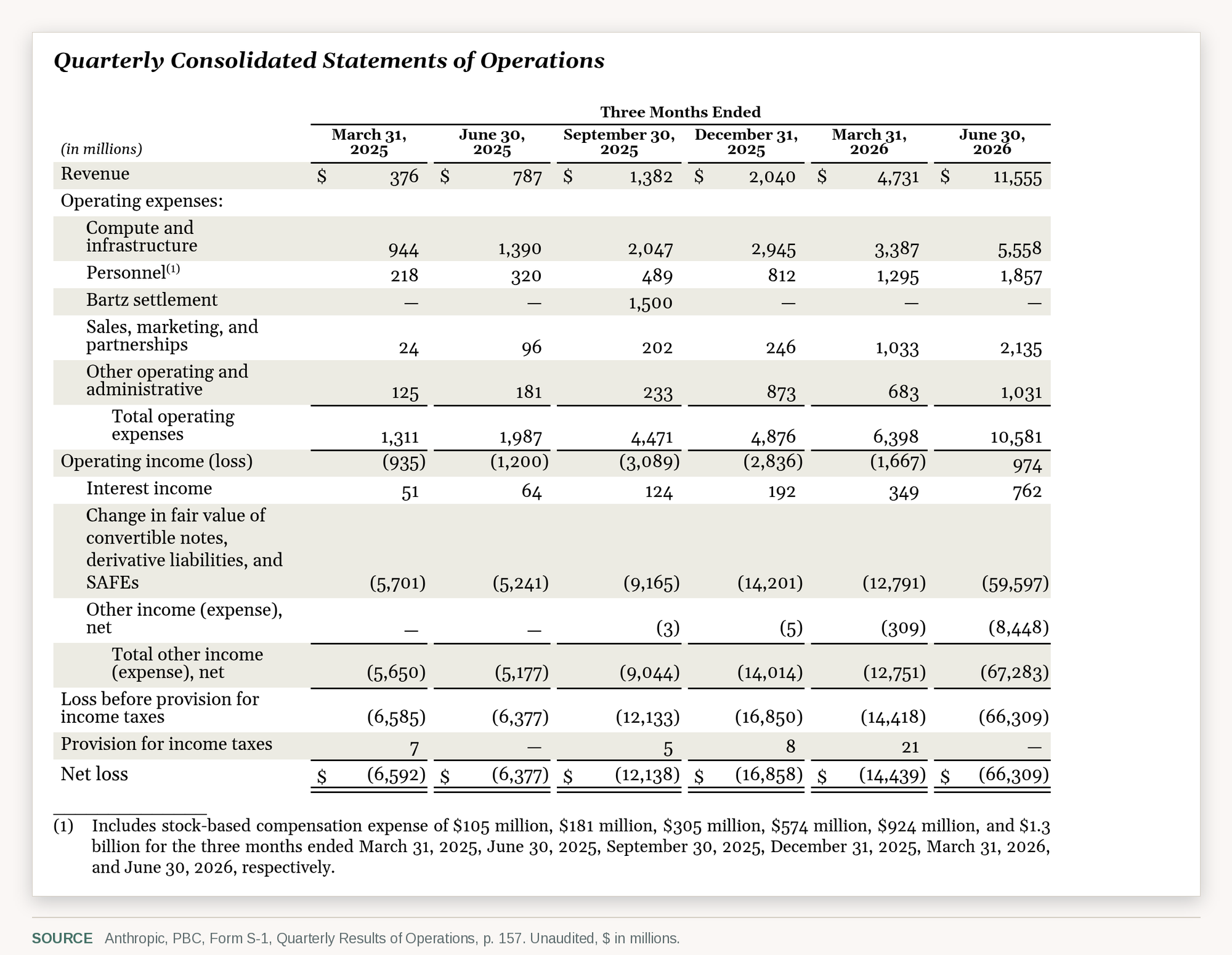
Anthropic's quarterly results: Source: Anthropic, PBC Form S-1, Quarterly Results of Operations, printed page 157 (unaudited, $ in millions).
Some folks dismiss Anthropic as "burning money by the millisecond" with free cash flow negative.
Here the gap is small. Ops produced $3.9 billion of cash in the half, against a $1.5 billion drain a year earlier, and purchases of property and equipment were only $482 million, because most compute comes from cloud providers and leases. On the simplest definition, free cash flow was about $3.4 billion positive, not negative.
The astute AI power-users might ask: which of the compute costs are inference and which are training? (Training is the expensive up-front part that goes into making the models with significant upfront costs. Inference is a more predictable cost incurred per transaction, per customer, to run the model on real queries).
This critical piece of data on operating costs was suspiciously absent from the filing, with some folks commenting online that "inference is extremely profitable, checkmate AI skeptics" for ignoring "the black hole that is training." The nearest thing is a footnote that sorts expenses by function.
Cost of revenue, which the filing describes as substantially all compute for customer-serving workloads plus some personnel and overhead, was $2.4 billion in the half. Research and development, mostly compute for model development, research and internal use, was $9.7 billion.
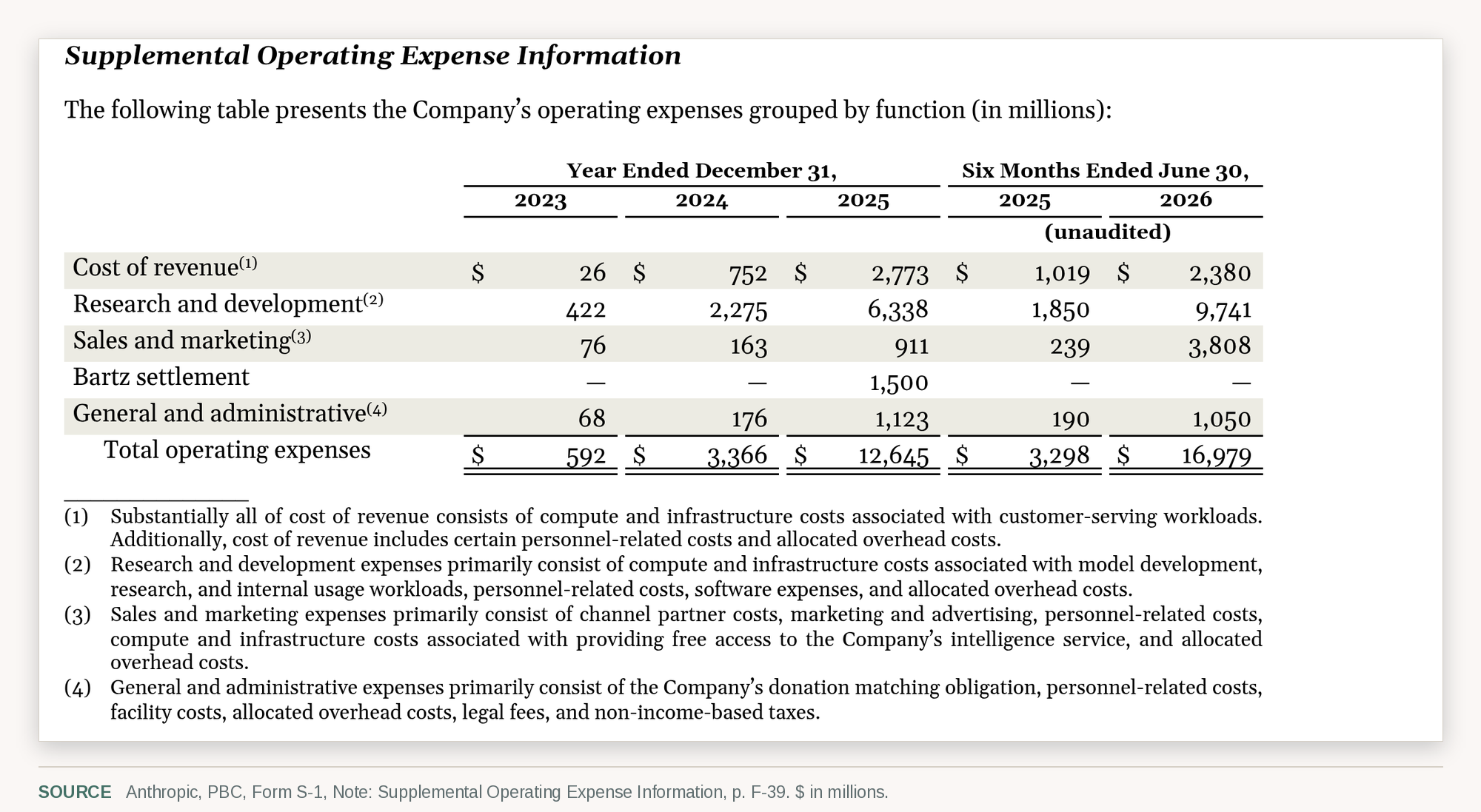
Source: Anthropic, PBC Form S-1, printed page F-39 (unaudited, $ in millions). Screenshot. View the full-size image.
The nuclear bomb for the valuation story is open models getting more competitive while inference may still be a very good business: Chinese model provider DeepSeek claims 155 trillion tokens a day from one cluster and $38 in revenue per card-hour at off-peak pricing. That's revenue, not profit, and the claim isn't independently verified here, but if the costs leave a healthy margin, Anthropic could face rivals that undercut it without losing money doing it.
Headline: Even the good profit number is small next to the price. A $974 million quarter annualizes, crudely, to $3.9 billion, and $2 trillion is about 500 times that.
This price rests entirely on profit Anthropic hasn't made yet, but we knew that, AI is a speculative investment on the future of "everything"?
Is this Google's IPO again?
Google closed its first trading day worth more than $25 billion on about $1.5 billion of revenue, and some have argued that a similar multiple, adjusted for growth, puts Anthropic well over $3 trillion. But Google is profitable, cash positive and nearly debt free.
Google's final prospectus and a later SEC exhibit have the numbers. In the first half of 2004 it earned $143 million on $1.35 billion of revenue, up 141% from a year earlier, at a 24% operating margin. The first-day close valued it at $27.2 billion, about ten times annualized revenue and 95 times annualized earnings. Anthropic at $2 trillion is about 30 times its annualized third-quarter revenue, on an 8% operating margin in its best quarter in the filing.
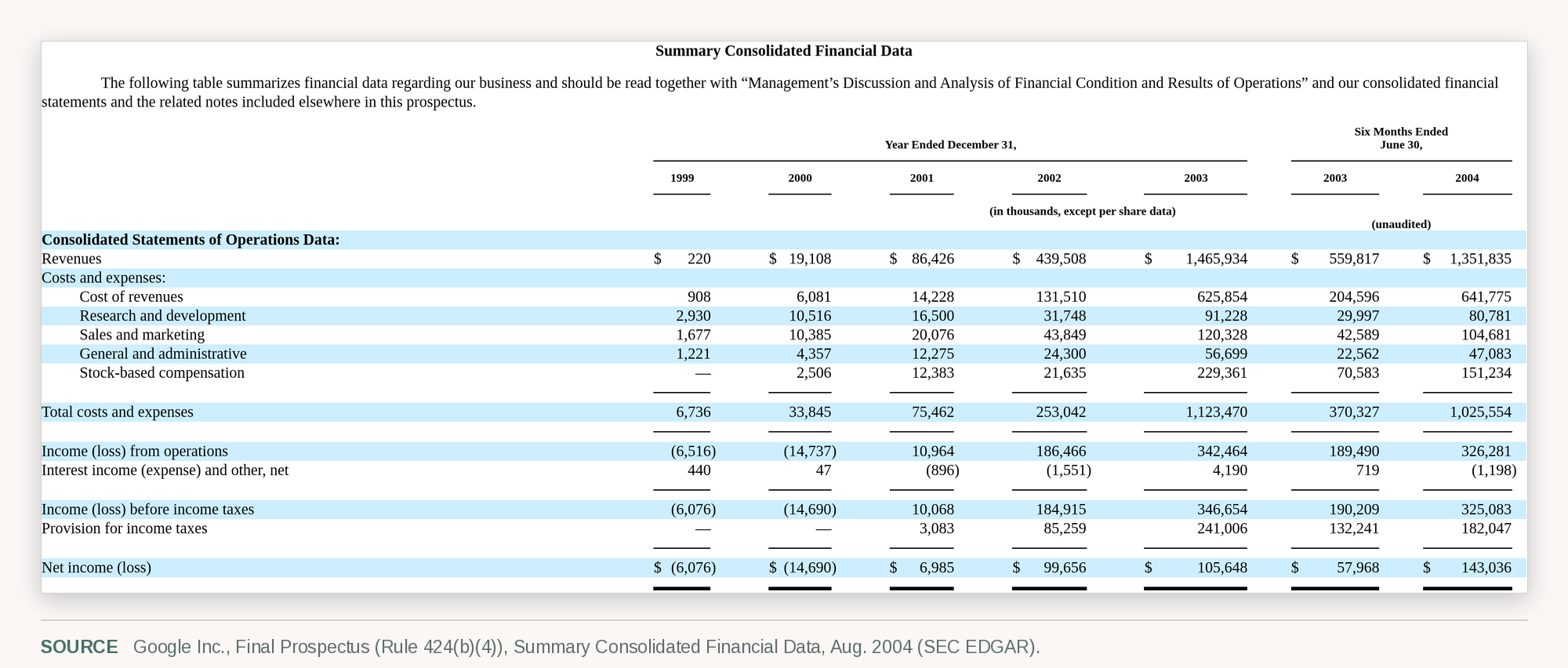
Source: Google Inc. final prospectus (Rule 424(b)(4)), SEC EDGAR. Screenshot. View the full-size image.
Google's summary financial data from its 2004 IPO prospectus: first-half 2004 revenue of $1.35 billion, operating income of $326 million and net income of $143 million (table in thousands).
Growth that fast earns a premium.
In that same half-year Google's operations produced $371 million of cash against $182 million of capital spending, so the business paid for its own build-out.
Anthropic's $131.7 billion of cash and short-term investments was mostly raised from investors: $110.8 billion of financing inflows in the half against $3.9 billion from operations.
What about data centers and GPUs
That revenue comes with HUGE obligations to keep paying: $265.6 billion of fixed or minimum purchase commitments, with terms from one to 20 years, and $321.4 billion of leases signed but not started.
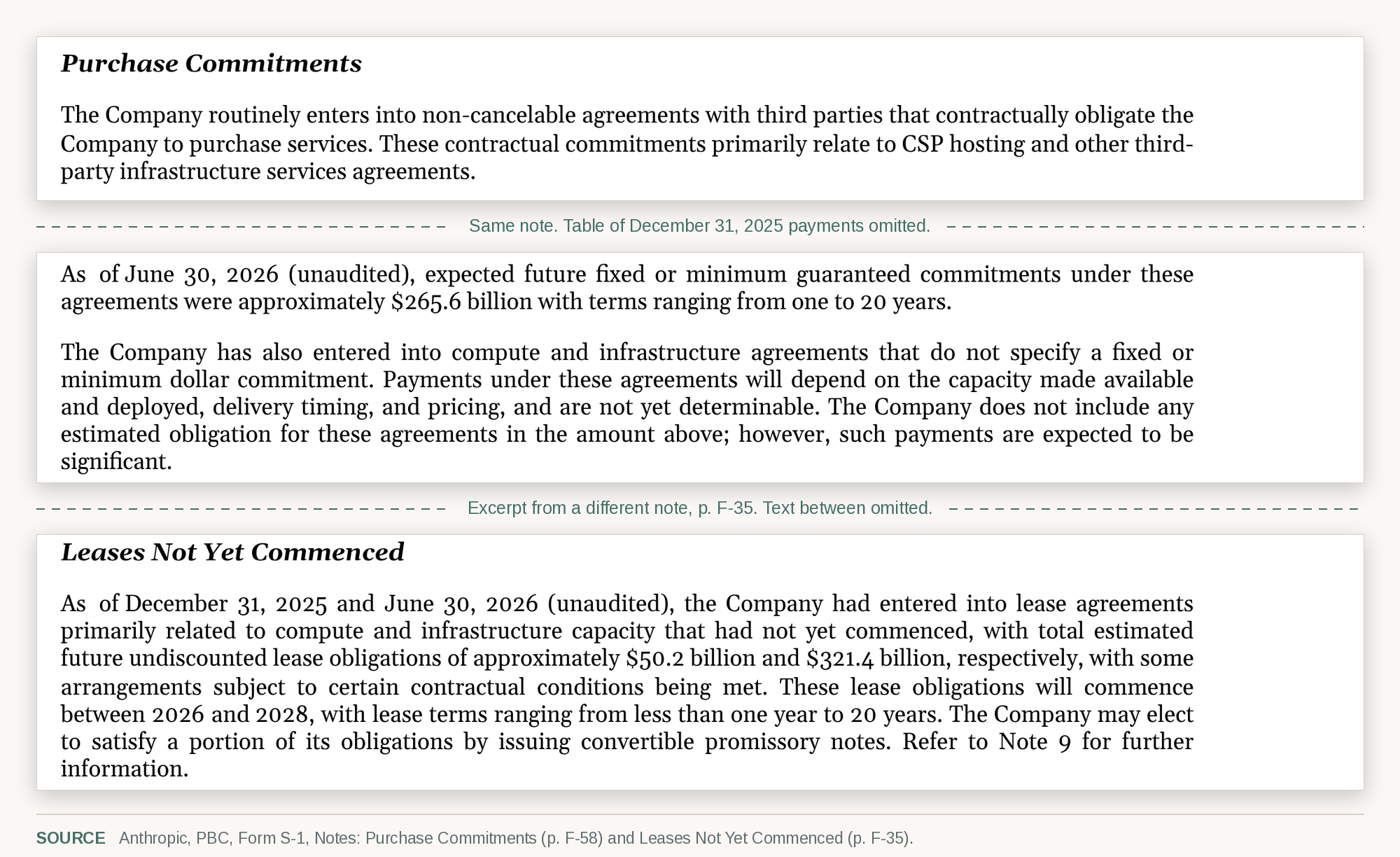
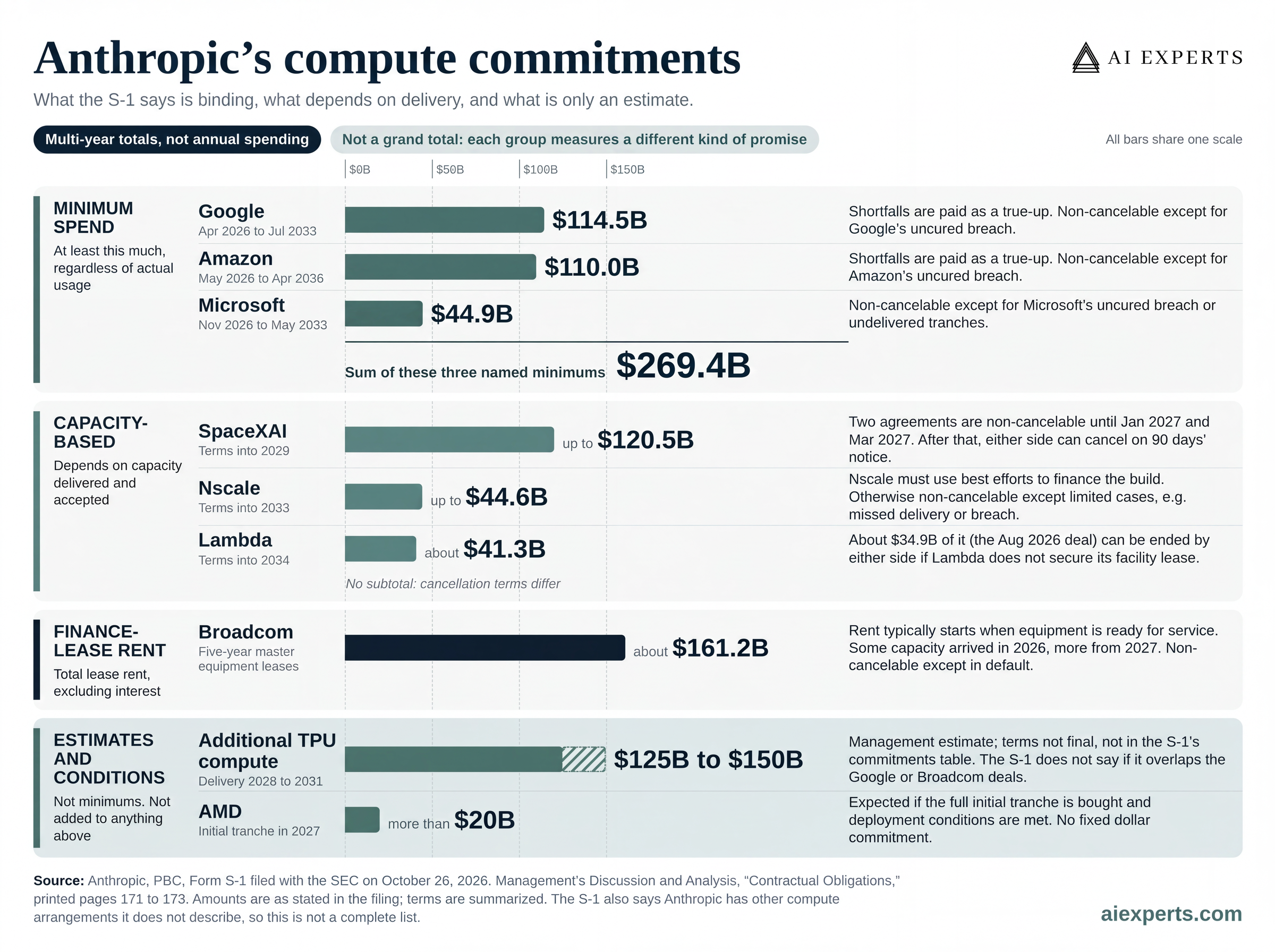
Source: Anthropic, PBC Form S-1, Management's Discussion and Analysis, "Contractual Obligations," printed pages 171 to 173.
Anthropic's compute commitments from the S-1, grouped by the kind of promise. Chart by AI Experts.
The names behind that infrastructure bet make the scale easier to grasp:
- $110 billion with AWS from May 2026 to April 2036
- $161.2 billion in Broadcom equipment rent under five-year leases, excluding interest
- SpaceXAI adds up to $120.5 billion of capacity through 2029
The S-1 says Anthropic expects to buy more costly short-term compute and its margins to compress.
(Essentially their demand is bursty, and every time demand spikes they're forced to look for temporary compute from more expensive providers off of their own hardware).
Many top customers, the filing says, lack long-term contracts or have contracts expiring soon, and the top five brought in about 25% of revenue! Anthropic is committed to paying GPU suppliers for years, while many of its customers can cut their spending much sooner. Yikes.
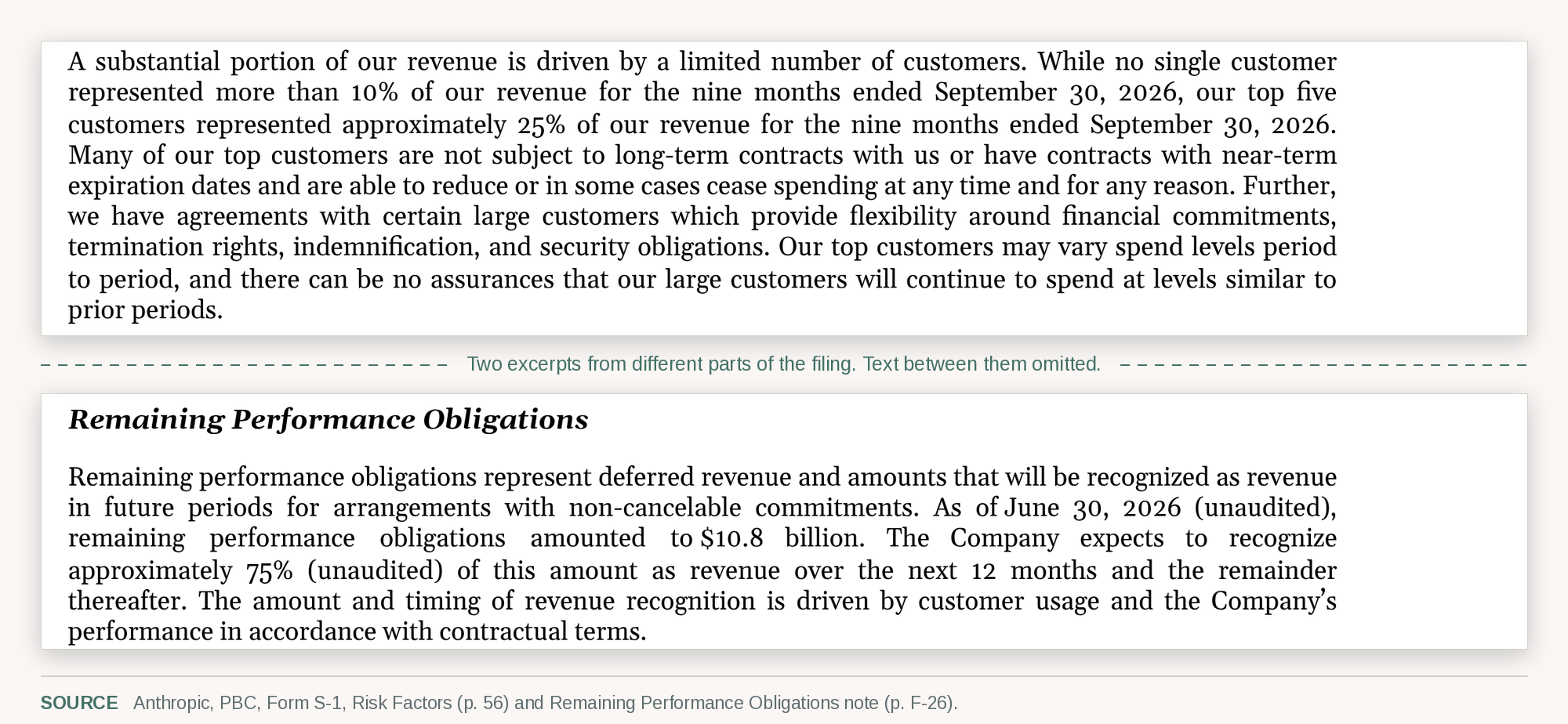
Anthropic, PBC Form S-1, Risk Factors (printed page 56) and Remaining Performance Obligations note (printed page F-26).
What price is fair to "Keep Thinking"
Some believe $500 billion is fair because there is no moat. Others find $1.5 trillion rich but not dependent on "AI maximalism." Many think SpaceX's multiple, which would put Anthropic at $3 trillion, is "an easy place to end up," in this wild hype-stock market.
Wall Street's version, as Reuters reported in August, is to value the company on projected 2028 revenue of roughly $190 billion to $200 billion, using Cloudflare, Palantir and SpaceX as reference points.
Here is my napkin math. Work backward and the company is worth a bit over $1.1 trillion today.
- Start at $195 billion in 2028.
- Assume growth slows to 35% in 2029 and 25% in 2030, which makes about $330 billion in 2030.
- Assume a mature Anthropic is worth 6x revenue, which is what 20 times earnings on a 30% net margin works out to.
- Assume you want 12% a year until the end of 2030.
With better margins and higher multiples, the answer moves a lot. $2 trillion needs a ten times multiple on top of a growth path that presently looks healthy, but is business blitzkrieg by historical standards.
IPO debut is expected the week of Thanksgiving.
In conclusion, and looking past the fundamentals for a second - Anthropic is a company which appears to be literally inventing the future with many of the brightest human minds on their team, hailing from the best companies, fueled by rocketship growth, and inspired by their own growing RSU equity valuations. This group of AI researchers and engineers have shown remarkable consistency pioneering the best features and models in a generationally competitive landscape.
I wouldn't bet against them to remain competitive into the future.
There is no guarantee of future success especially as AI models are increasingly commoditized and compared on cost-basis with open weight alternatives, but someday we just might find a profitable version of Anthropic safely worth $2 trillion+ dollars built on legacy business fundamentals and math, not AI hopium, and that's a truly remarkable story to behold.
This is not investing advice. This article is for informational purposes only and is not a recommendation to buy or sell any securities.
References
- Anthropic, PBC, Form S-1, filed October 26, 2026
- SEC EDGAR filing index
- Anthropic: S-1 announcement
- Anthropic: Series H announcement
- Fortune, October 26, 2026
- Reuters, August 15, 2026
- Reuters via Investing.com, October 14, 2026
- Google: final prospectus (Form 424B4)
- Google: SEC exhibit 99.01
- Los Angeles Times, August 20, 2004: Google debut
- The New York Times, August 19, 2004: Google debut
- Hacker News discussion
- DeepSeek claim via Zhihu (Chinese-language post): 155 trillion tokens a day, $38 revenue per card-hour. Provider claim, not independently verified

Written by Lucas Erb
Founder of AI Experts